Insurance companies often send Explanation of Benefits statements that include multiple patients on a single page. From a billing workflow perspective, this feels efficient. From a compliance perspective, it can quietly create risk if handled incorrectly.
This question comes up frequently in dental offices.
Is it wrong to keep a scanned EOB page that lists two or three patients in the documents of just one patient?
The short answer is yes, unless it is handled properly.
Table of Contents
ToggleWhy multi-patient EOBs can become a problem
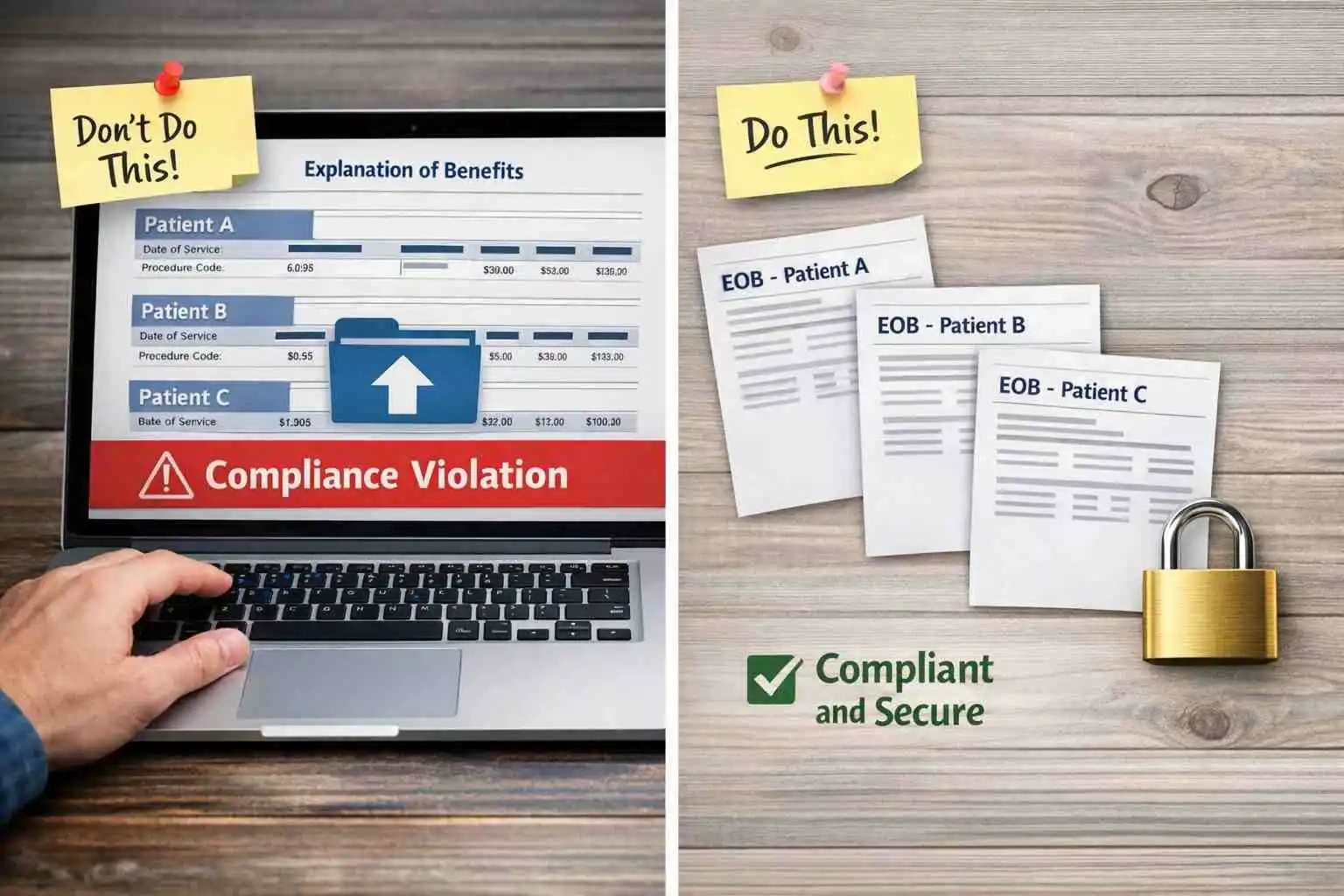
When an EOB that includes Patient A, Patient B, and Patient C is scanned or uploaded into Patient A’s chart without modification, the record now contains protected health information belonging to other patients.
That is where the issue begins.
Under HIPAA’s minimum necessary rule, a patient’s chart should only contain information relevant to that specific patient. Other patients’ names, subscriber IDs, dates of service, and payment details do not belong in that record.
The minimum necessary rule means you should only access or share the patient information you actually need to do your job. Offices must review their processes and make sure patient information is protected and not shared unnecessarily. The rules are flexible, but reasonable safeguards must always be in place.
This is not about intent. It is about document control.
During audits, this is a common finding. Auditors view it as weak safeguards around protected health information, even if the practice meant no harm and even if access is limited to staff only.
Do and Do Not checklist to train your dental office team
DO’s Scenario
Step 1: Follow office policies when handling patient information
The biller checks the office policy and sees that multi-patient EOBs must be split, redacted, or stored in a central billing folder before being uploaded.
Step 2: Share only the information needed to complete the task
The biller separates the EOB and uploads only the portion related to Patient A into Patient A’s chart. Information for Patients B and C is not included in Patient A’s record.
Step 3: Ask a supervisor if unsure
The biller is not sure whether the EOB can be split in the system. Instead of guessing, the biller asks a supervisor for guidance before uploading anything.
Step 4: Protect patient information at all times
The full EOB is saved securely in the billing folder with limited access, and no patient can see information that does not belong to them.
Result
Patient information is protected, office policy is followed, and the practice remains compliant and audit-ready.
DO NOT Scenario: What Went Wrong
A biller receives an EOB from an insurance company that includes four patients on one page.
Mistake 1: Sharing extra patient information
The biller uploads the full EOB into Patient A’s chart, even though the page also lists Patients B, C, and D. Patient A’s record now contains information that is not needed for their account.
Mistake 2: Assuming one rule covers everything
The biller assumes that because the insurance company sent the EOB this way, it must be acceptable to store it the same way, without checking office policy or HIPAA guidance.
Mistake 3: Uploading multi-patient documents into one chart
The entire EOB is saved as-is into a single patient chart instead of being split, redacted, or stored centrally.
Mistake 4: Ignoring privacy concerns
When another team member raises a concern, the biller responds, “We have always done it this way,” and does not correct the issue.
Result
The patient chart now contains other patients’ protected health information. If audited, this would likely be flagged as a compliance violation and require corrective action.
What is considered compliant and acceptable
Dental offices have a few safe and defensible options. The key is consistency and documentation.
Split the EOB by patient
This is the cleanest approach. Electronically separate the EOB so that each patient’s chart only contains their own portion. This is considered best practice and holds up well in audits.
Redact other patients before uploading
If splitting is not practical, fully redact all other patient identifiers before attaching the document to a chart. This includes names, member IDs, dates of service, and payment amounts.
Store the full EOB outside patient charts
Another compliant option is to keep the complete EOB in a centralized billing or insurance folder. Individual patient ledgers can be posted from it without attaching the full document to any one patient record.
What should be avoided?
There are a few common shortcuts that create unnecessary exposure.
Uploading a multi-patient EOB as-is into a single patient’s chart
Assuming it is acceptable because the insurance company sent it that way
Relying on internal access controls to justify mixed patient documentation
Auditors focus on what is visible within each patient’s chart, not how busy the billing department was or how the payer formats its EOBs.
A practical billing reality
Yes, insurance companies love putting multiple patients on one page. Yes, splitting or redacting EOBs takes extra time. And yes, this is exactly how long-standing habits turn into audit findings.
A simple internal policy stating that EOBs must be split or redacted before being uploaded goes a long way. It protects the practice, keeps billing clean, and demonstrates that compliance is intentional, not accidental.
Old school discipline. Modern compliance. Fewer headaches later.
If you would like, this can easily be turned into a one-page SOP or training handout for your billing team so it is followed consistently across all locations.