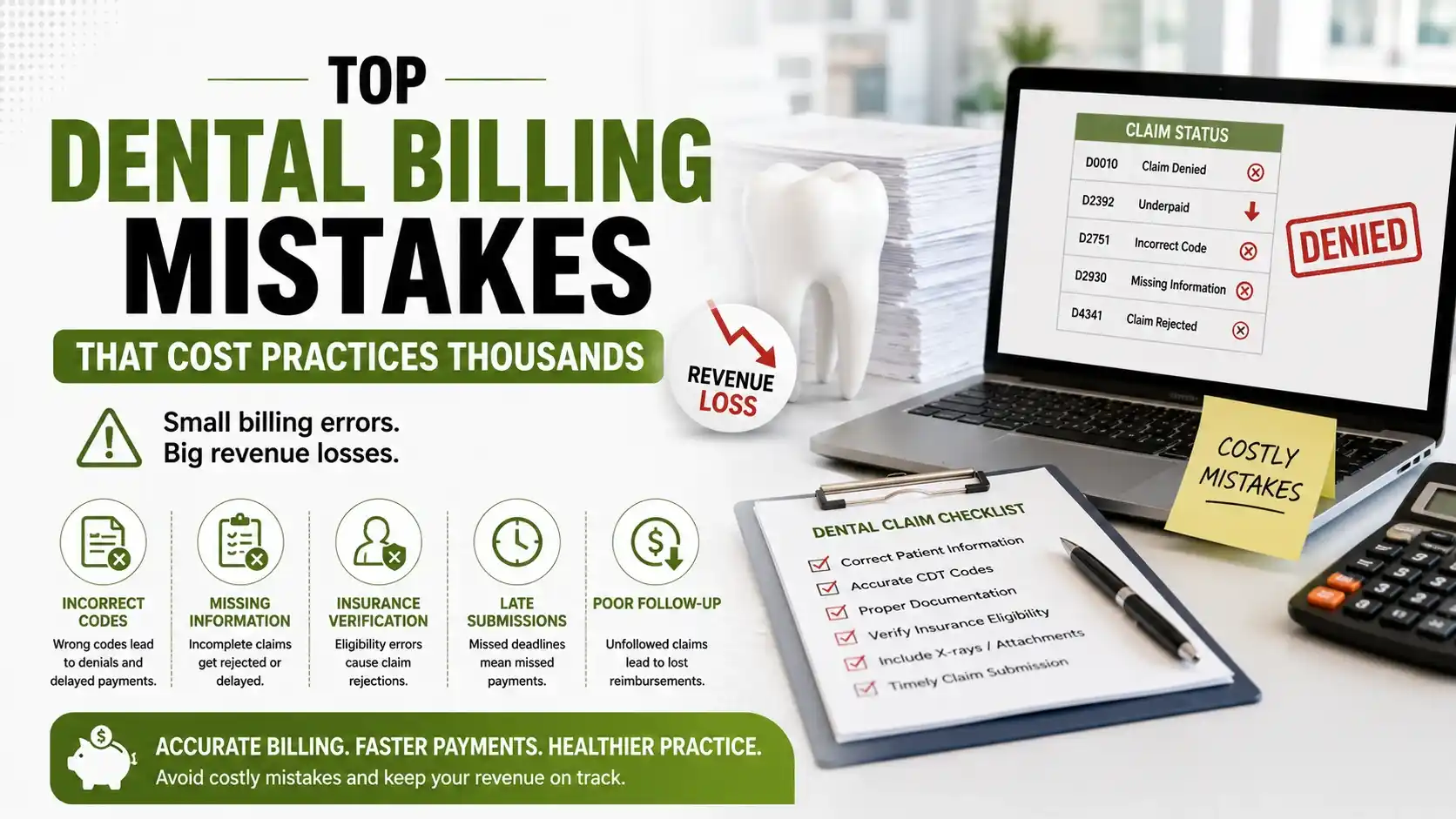
Dental revenue cycle management has always been complex, but in recent years it has become even more demanding. Insurance policies keep changing, network structures are expanding, and benefit coordination has added new layers of confusion that most front-office teams weren’t built to manage. On top of that, staffing shortages are forcing practices to handle more work with fewer people.
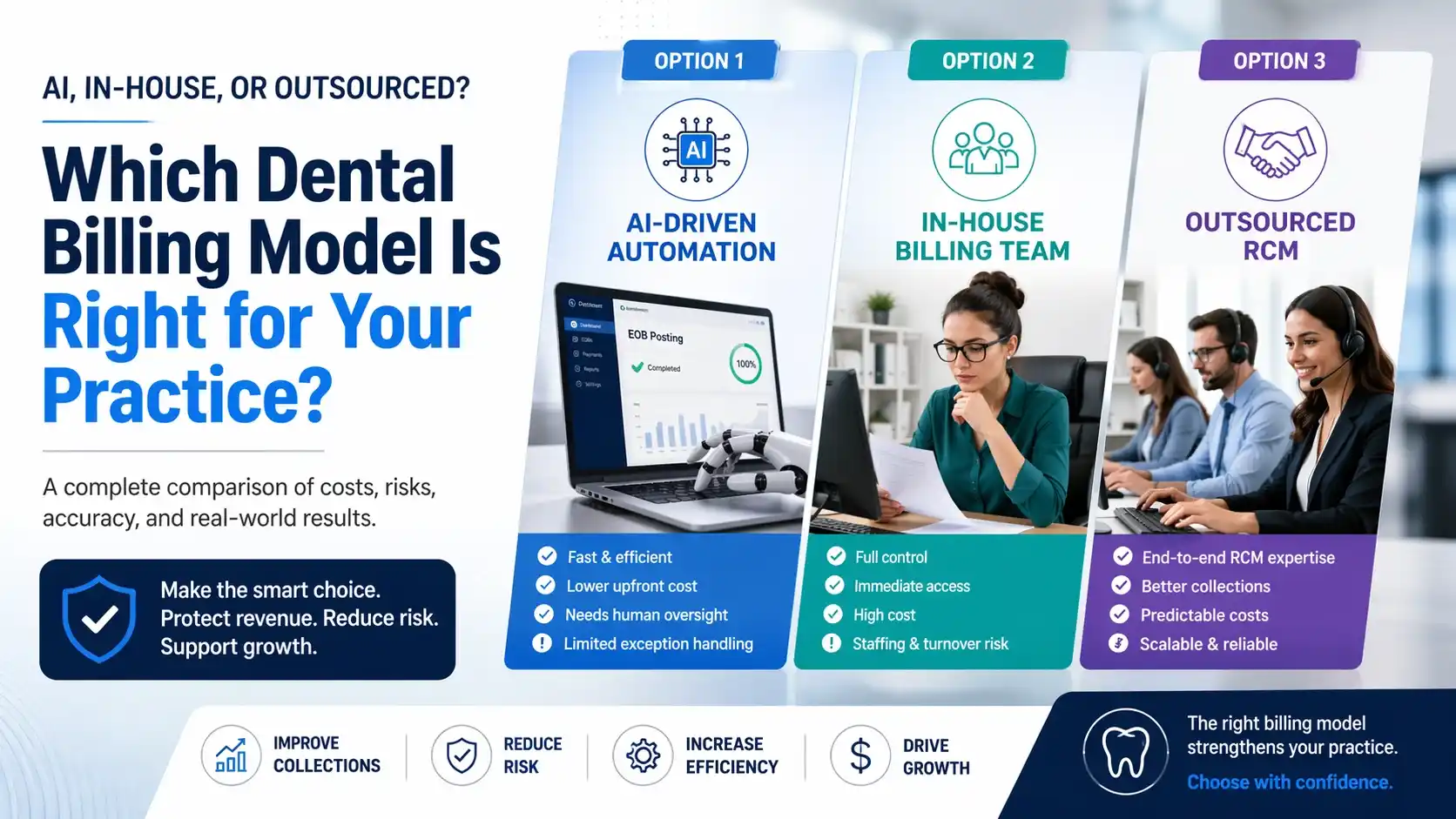
Today, dental practices typically rely on three main approaches for billing: AI-driven automation, in-house billing teams, and outsourced revenue cycle management (RCM). Each option brings clear benefits—but also hidden risks that can directly impact profitability.
This guide offers a practical, numbers-based comparison of these models using realistic assumptions for a typical PPO practice. It also looks at accuracy, compliance, staffing reliability, and scalability—so dentists and office managers can choose a system that improves collections, reduces risk, and supports long-term growth
Table of Contents
ToggleThe Core Challenge: Accuracy Over Speed
Before comparing models, it’s important to understand the real issue in dental billing—it’s not speed, it’s accuracy.
Explanation of Benefits (EOBs) are often inconsistent, leading to issues like:
- Misclassified non-covered services
- Incorrect downgrades
- Missing documentation requests that look like denials
- Disallowed procedures needing follow-up instead of write-offs
If these are posted incorrectly, the practice absorbs the loss—often amounting to hundreds or even thousands each month.
That’s the real problem.
A system focused only on speed without ensuring accuracy may look efficient but quietly reduces revenue.
Option 1: What AI Billing Tools Do Well
AI billing platforms have grown in popularity because they automate repetitive tasks. Tools like Lassie can pull EOBs and ERAs, interpret data, and post payments directly into systems like Dentrix, Eaglesoft, or Open Dental—often reducing hours of manual work to minutes.
Where AI Helps:
- Faster payment posting
- Consistency in routine tasks
- Reduced manual data entry
- Better visibility into payments
Where AI Falls Short:
-
Handling Exceptions
AI still struggles with:
- Non-standard EOB formats
- Regional payer variations (especially BCBS plans)
- Secondary insurance coordination
- Complex downgrades and narratives
-
Need for Human Oversight
- Errors still occur
- Edge cases require review
- Supervision is essential
-
Integration Issues
Some practices report:
- Incorrect payer setup
- Payment routing errors
- Delays in resolving payer-specific issues
In real cases, poor setup has caused NSF charges and manual rework—creating operational risk.
Cost Overview:
- Onboarding: $2,500–$3,000
- Ongoing: ~2% of collections
Example:
- $500K revenue → ~$10K/year
- $1M revenue → ~$20K/year
While cost-effective, practices still need internal time for monitoring and corrections.
Option 2: In-House Billing Teams
In-house billing has long been the traditional approach. It offers control and familiarity but comes with significant costs and risks.
Costs:
- Salary: $55,000–$70,000
- Total cost (with benefits, taxes, training): $70,000–$85,000 annually
Challenges:
- Dependence on a few individuals
- Disruptions during absence or turnover
- Time-consuming training
- Process inconsistencies
Hidden Risk: Revenue Leakage
Even a 3–7% inefficiency can lead to major losses.
For a $700K practice, that’s $21,000–$49,000 annually—often unnoticed but impactful over time.
Option 3: Outsourced Revenue Cycle Management
Outsourcing shifts the entire billing process to a specialized team that handles:
- Claims submission
- Payment posting
- AR follow-up
- Denial management
- Reporting
Unlike AI, outsourcing combines execution with expertise.
Key Advantage:
A trained billing team doesn’t just post—they analyze, question, and correct.
Cost:
- Typically 3–4% of collections
- Example: $700K revenue → ~$24,500/year
Return on Investment:
If collections improve by just 5%, that’s an additional $35,000—resulting in a net gain even after service costs.
Financial Comparison
- AI Billing: ~$14,000/year
- Covers posting only
- Moderate risk
- Saves time but limited recovery
- In-House Billing: $70K–$85K/year
- Full cycle (limited capacity)
- High risk due to variability
- Expensive with hidden losses
- Outsourced RCM: ~$24,500/year
- Full revenue cycle management
- Lower risk
- Strong balance of cost and performance
Operational Reality
Cost is only part of the decision—reliability matters just as much.
- AI depends on clean data and monitoring
- In-house teams depend on individuals
- Outsourced teams rely on structured workflows and performance tracking
Scalability:
- In-house → requires hiring
- AI → costs grow with collections
- Outsourcing → scales efficiently without major disruption
Compliance and Risk
One critical truth:
When you stop closely tracking your numbers, problems build quietly.
Automation can create false confidence. If posting, adjustments, or payments are incorrect, you may not notice immediately—but your accounts receivable will reflect it within 60–90 days.
Even AI must be audited—it cannot run on blind trust.
The Hybrid Approach: The Best of Both
In real-world practices, one trend is clear:
AI alone isn’t enough. Humans alone aren’t scalable.
The most effective model combines both:
- AI handles 70–90% of repetitive tasks
- Humans manage:
- Exceptions
- Denials
- Underpayments
- Strategy
This approach:
- Reduces workload
- Maintains accuracy
- Protects revenue
So, Which Model Is Best?
Choosing between AI, in-house, and outsourcing isn’t just about cost—it’s about how well your practice manages revenue and risk.
- AI offers efficiency
- In-house offers control
- Outsourcing offers consistency and performance
For most practices, outsourcing delivers the strongest balance of cost control, revenue growth, and operational stability. AI will continue to evolve, but human expertise remains essential.
Final Thought: It’s About Control, Not Just Technology
AI is not the future of n—controlled systems are.
Whether your system includes:
- AI
- Human teams
- Or a combination of both
The goal remains the same:
- Accurate posting
- Clean accounts receivable
- Predictable cash flow
AI tools are powerful—but they’re not “set and forget.”
They are:
- Accelerators, not replacements
- Assistants, not decision-makers
The practices that succeed won’t just adopt new tools—they’ll build systems that keep their revenue accurate, consistent, and under control.