Table of Contents
ToggleIntroduction
Dental practices today operate within an insurance environment that is becoming increasingly complex. Administrative requirements continue to expand, payer policies evolve frequently, and documentation expectations have become more stringent. As dental insurance represents a growing portion of practice revenue, the ability to manage claim denials effectively has become a critical component of financial stability.
According to the National Association of Dental Plans (NADP), more than 2.5 billion dental claims are processed annually in the United States, making dental insurance claims one of the largest administrative workflows in healthcare. Within this enormous volume, claim rejections and denials occur regularly due to documentation deficiencies, benefit limitations, coordination of benefits issues, and payer policy requirements.
NADP Dental Benefits Report – Claims Metrics
This page explains that the report provides benchmarking data on dental claims processing operations, including metrics used by dental insurers and administrators.
Industry estimates suggest that approximately 10–15 percent of dental claims require rework or resubmission due to denials or processing errors. While this percentage may appear modest, the operational consequences for dental practices are significant. Each denied claim introduces additional administrative work, delays collections, and places pressure on billing teams.
For many dental practices, claim denials are still treated as routine billing obstacles. However, the pattern that is emerging across the industry suggests something different. Denials increasingly represent a systemic revenue cycle challenge, one that affects cash flow predictability, operational efficiency, and long-term profitability.
Addressing this challenge requires more than reactive resubmissions. It requires a structured approach to denial prevention, documentation integrity, and disciplined recovery processes.
Why Dental Claim Denials Are Increasing
Many dental practices have noticed that claim denials appear to be occurring more frequently, even when billing processes remain unchanged. This trend is not accidental. Several structural changes within the insurance industry are contributing to higher denial volumes.
Expanding Documentation Requirements for Medical and Dental Necessity
One of the most significant drivers of dental claim denials is the growing emphasis on medical necessity and dental necessity documentation.
Insurance carriers increasingly expect clinical records to clearly demonstrate why a procedure is required. Even when treatment is clinically appropriate, reimbursement may be denied if documentation does not adequately support the necessity of the service.
For example, procedures such as crowns, periodontal therapy, root canal treatment, and implant restorations frequently require detailed supporting documentation. Radiographs, periodontal charting, clinical notes, and narrative explanations often play a critical role in determining whether the claim meets payer requirements for medical necessity or dental necessity.
When documentation fails to demonstrate this necessity clearly, claims may be denied despite proper treatment.
The Rise of AI Powered Denial Systems
Another important development influencing claim denials is the increased use of AI powered denial systems by insurance carriers.
Modern claims review systems rely on automated algorithms that analyze billing patterns across thousands of providers. These systems evaluate factors such as:
- frequency of procedures
- diagnosis patterns
- documentation consistency
- provider billing trends
- historical claim data
When a claim falls outside the statistical patterns expected by the system, it may automatically be flagged for denial or additional review.
While these systems are designed to detect billing irregularities, they often create new administrative challenges for dental practices. Claims that previously processed routinely may now be subjected to additional scrutiny due to automated review triggers. “Practices must now be more cautious to prevent insurance audits especially in California, Texas, New York, Connecticut, Florida, New Jersey and many other states.
Increasing Administrative Complexity
Insurance policies continue to evolve with new requirements related to:
- prior authorizations
- frequency limitations
- coordination of benefits
- coverage exclusions
- plan specific documentation rules
Each of these variables introduces another potential point where a claim may fail during processing.
As complexity increases, the margin for administrative error becomes smaller.
The True Cost of Claim Denials for Dental Practices
Claims denials are often discussed only in terms of unpaid revenue. However, the real impact extends much further across the practice.
Direct Financial Loss
The most immediate effect of a denial is the interruption of expected revenue.
What should have been predictable reimbursement becomes uncertain. Some denied claims are eventually recovered through appeals, but many are lost due to missed deadlines or unsuccessful appeals.
Over time, this creates a pattern of revenue leakage that affects financial planning and profitability.
Extended Accounts Receivable Cycles
Denied claims often remain unresolved for extended periods. When accounts receivable aging increases, the probability of recovering payment decreases.
Longer A/R cycles also reduce cash flow predictability, making it more difficult for practices to forecast revenue accurately.
Operational Strain on Billing Teams
Denial management is labor intensive. Each denied claim requires investigation, correction, documentation review, and often multiple follow ups with the insurance carrier.
Billing teams must dedicate time to these activities while still managing routine claims processing. As denial volumes increase, staff productivity often declines.
Impact on Patient Experience
Claim denials frequently create confusion for patients. When insurance payments are delayed or denied, patients may receive statements showing balances they did not anticipate.
This can lead to increased patient inquiries, frustration, and delays in patient payments.
Over time, inconsistent insurance outcomes may affect patient trust in the practice’s billing process.
Where Claim Denials Originate in the Dental Revenue Cycle
Claim denials rarely originate from a single mistake. In most cases, they reflect breakdowns that occur at different stages of the revenue cycle.
Understanding these failure points is essential for prevention.
Front End Revenue Cycle Breakdowns
Many denials originate before treatment is even provided.
Common front end issues include:
- incomplete insurance verification
- incorrect policy information
- inaccurate patient demographics
- coordination of benefits errors
When foundational information is incorrect, even properly performed treatment may not be reimbursed.
Authorization and Coverage Issues
Some dental procedures require prior authorization or pre determination before treatment is performed.
Claims may be denied when:
- authorization was not obtained
- authorization expired
- authorization does not match the procedure performed
In other cases, the procedure may simply fall outside the patient’s benefit coverage.
Documentation and Dental Necessity Issues
Claims frequently fail when documentation does not adequately demonstrate medical necessity or dental necessity.
For example:
- crown replacements without evidence of structural damage
- periodontal therapy without supporting charting
- surgical procedures without diagnostic documentation
Even minor gaps in clinical documentation can trigger denials.
Coding and Billing Errors
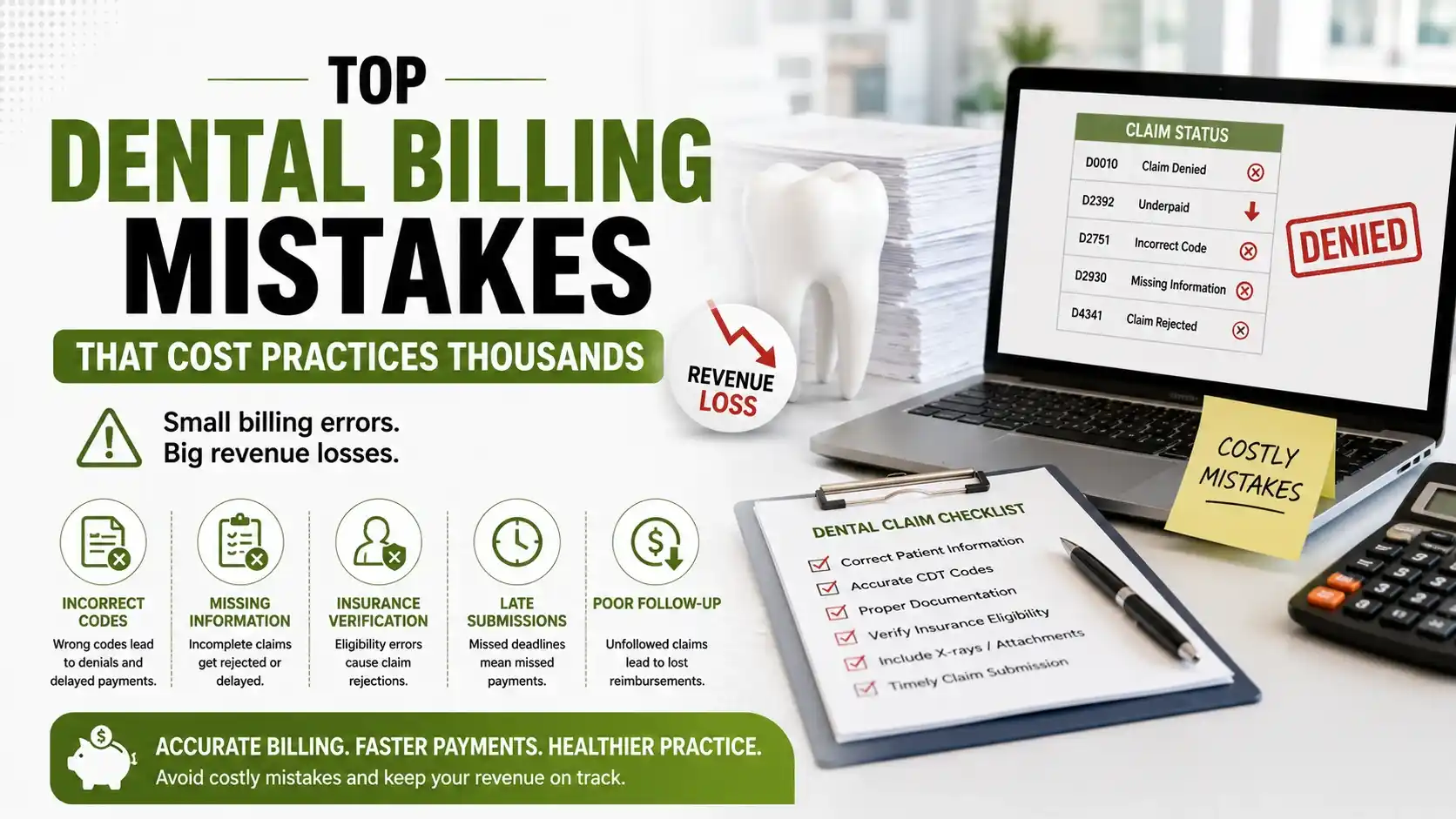
Technical errors during claim submission are another common source of denials.
Examples include:
- incorrect CDT codes
- missing modifiers
- diagnosis and procedure mismatches
- duplicate claim submissions
While these errors may appear minor, they can significantly delay reimbursement.
Administrative Compliance Failures
Claims may also be denied when administrative requirements are not met, including:
- missing attachments
- incomplete narratives
- claims submitted after timely filing deadlines
Many of these denials are preventable through improved billing workflows.
Understanding Denial Codes
When a claim is denied, the explanation typically appears on the remittance advice as a series of adjustment codes.
These codes communicate the reason for non payment and help determine whether the denial is recoverable.
Common categories include:
Contractual obligation codes (CO)
These represent adjustments required by the provider’s contract with the payer.
Other adjustment codes (OA)
These usually indicate administrative errors or missing information.
Payer initiated reductions (PI)
These reflect denials based on coverage rules or benefit limitations.
Patient responsibility codes (PR)
These indicate that the balance is assigned to the patient due to deductibles, copayments, or non covered services.
Understanding these codes is essential for determining the correct response strategy.
Responding to Claim Denials Strategically
Effective denial management requires more than simply resubmitting claims. A disciplined strategy ensures that resources are focused on claims with a realistic path to recovery.
Step 1: Determine Whether the Denial Is Recoverable
Not all denials should be appealed.
A careful review of denial codes, payer remarks, contractual obligations, and patient benefits helps determine whether recovery is possible.
Without this evaluation, practices may waste time appealing claims that cannot be overturned.
Step 2: Correct and Resubmit Claims Accurately
When a denial is correctable, the claim must be updated carefully.
Corrections may involve:
- updating insurance information
- revising CDT codes
- adding required modifiers
- resolving coordination of benefits issues
Accuracy is critical, as repeated errors can trigger additional denials.
Step 3: Submit Strong Appeals for Medical Necessity Denials
Appeals for medical necessity or dental necessity denials require thorough documentation.
Successful appeals typically include:
- detailed clinical narratives
- supporting radiographs
- periodontal charting
- provider documentation
- references to payer policy guidelines
Generic appeal letters rarely succeed. Clear clinical justification is essential.
Step 4: Monitor Appeal Deadlines
Insurance carriers enforce strict deadlines for claim corrections and appeals.
If these deadlines are missed, the claim may become unrecoverable regardless of accuracy.
Structured tracking systems help ensure that every denied claim is addressed before filing limits expire.
Why Many Dental Practices Struggle to Recover Denied Revenue
Despite having experienced billing staff, many dental practices still struggle to recover denied claims consistently.
Several factors contribute to this challenge.
Denial management is often treated as a secondary task rather than a dedicated function. Billing teams must balance denial work with routine claims processing.
Limited staff resources make it difficult to investigate denials thoroughly or develop strong appeal documentation.
In many cases, denial patterns are not analyzed systematically. As a result, the same issues continue to recur.
Over time, recoverable claims may be written off simply because the practice lacks the time or resources to pursue them.
Preventing Revenue Loss Through Structured Denial Management
Recovering denied revenue consistently requires more than reactive corrections. It requires structured processes, specialized expertise, and consistent follow through.
Effective denial management involves:
- analyzing payer denial patterns
- improving documentation standards for medical necessity and dental necessity
- implementing disciplined claim tracking processes
- developing payer specific appeal strategies
When these elements are applied consistently, practices can significantly reduce denial rates and improve recovery outcomes.
Final Thoughts
Claims denials have become a persistent challenge for dental practices. As payer policies evolve and AI powered denial systems become more common, the administrative burden on practices will likely continue to grow.
Practices that rely solely on reactive billing processes often find themselves trapped in an endless cycle of denials and resubmissions.
Those that adopt structured denial prevention strategies, strengthen documentation for medical necessity and dental necessity, and implement disciplined recovery workflows are better positioned to protect their revenue.
In an increasingly complex insurance environment, denial management is no longer simply a billing task. It is a critical component of revenue cycle strategy.
Need Help Recovering Denied Dental Claims?
If claim denials continue to disrupt your collections despite your team’s best efforts, it may be time to adopt a more structured approach.
BEANbite specializes in dental revenue cycle management, including denial prevention, payer negotiation, and strategic appeal support.
Our team works with dental practices to:
- reduce denial rates
• improve claim recovery
• strengthen documentation for medical and dental necessity
• protect long term practice revenue
Contact BEANbite today to learn how a structured denial management strategy can help safeguard your practice’s financial stability.