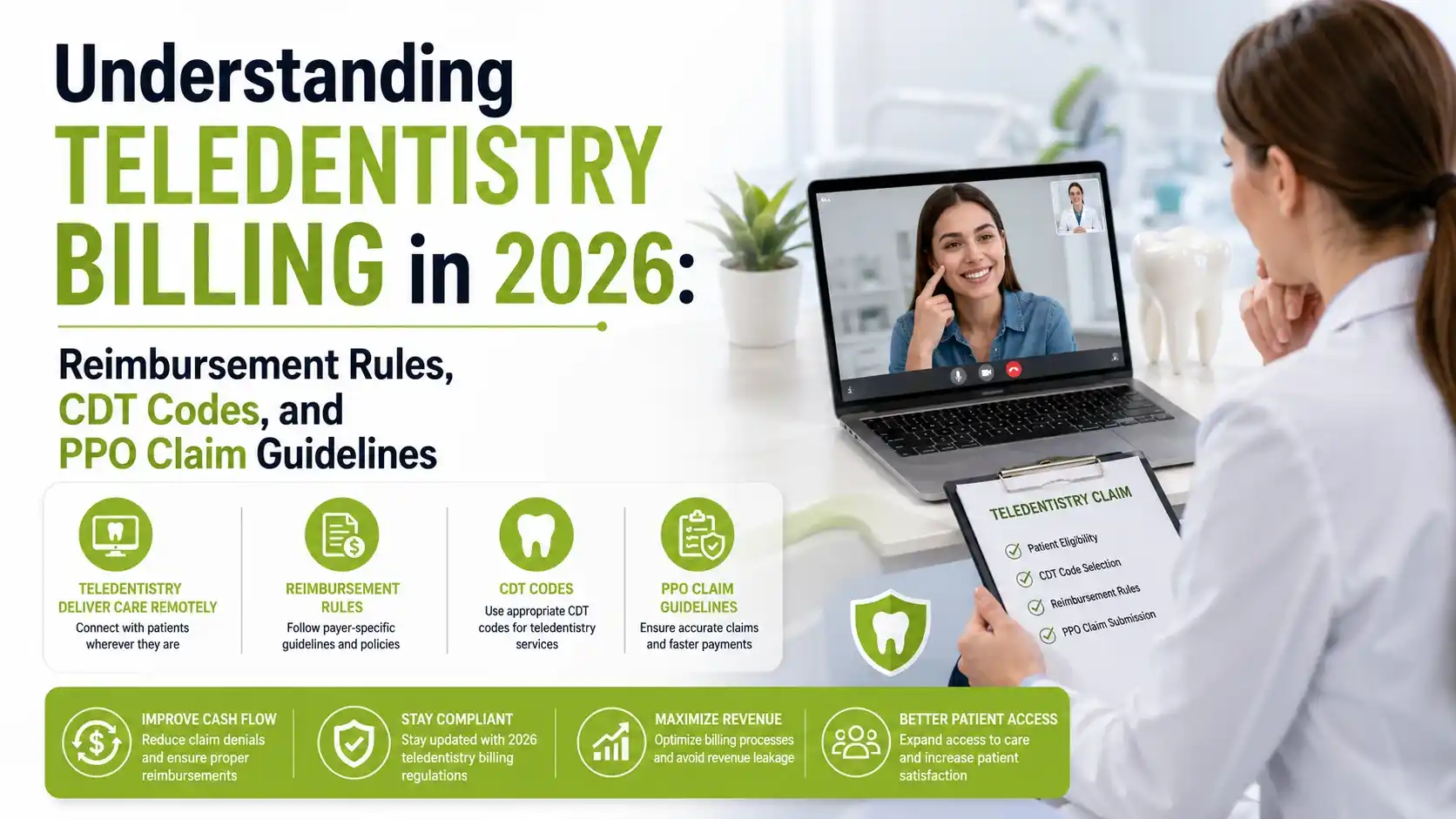
Teledentistry has become an important part of modern dental care in 2026. Many dental practices now use virtual consultations to improve accessibility and strengthen patient communication. However, reimbursement and billing confusion continue to create major challenges behind the scenes.
Insurance carriers often evaluate teledentistry claims differently. This leads to inconsistent reimbursement outcomes, reporting confusion, and claim submission issues. So, how do teledentistry claims actually work, and why are reimbursements often so inconsistent? Lets understand here!
Table of Contents
ToggleWhy Teledentistry Still Matters in Modern Dental Care
Teledentistry continues to play an important role in modern dental care because it improves accessibility, strengthens patient communication, and supports more flexible care delivery. Yes, teledentistry initially expanded during the COVID-19 period. However, it has now evolved into a long-term part of how many dental practices interact with patients. This is exactly why both patients and providers continue to rely on teledentistry in 2026.
Several factors have contributed to this continued relevance, including:
-
Growing Patient Demand for Virtual Dental Access
Patient expectations around healthcare access have changed significantly over the last few years. Today, many individuals expect the flexibility to communicate with providers remotely before scheduling in-office treatment. Dental care is no exception.
This growing demand is one of the biggest reasons teledentistry continues to remain relevant in modern dental care. Many patients now prefer virtual consultations for:
- Preliminary discussions
- Second opinions
- Post-treatment follow-ups
- Symptom evaluations
Many patients also prefer access to these services before visiting the office physically. Many patients even report feeling more comfortable discussing treatment concerns and asking questions during a virtual consultation before committing to care.
-
Improved Access to Dental Care Through Teledentistry
Teledentistry helps overcome barriers that once prevented many patients from accessing dental care conveniently. These include:
- Patients living in remote locations
- Individuals with mobility limitations
- Those with scheduling constraints
These patients often struggle to attend immediate in-office consultations. Virtual communication tools have, however, helped bridge this gap by making preliminary dental guidance more accessible. This improves continuity of care while allowing dental practices to remain connected with patients between appointments.
-
Strategic Use of Teledentistry in Modern Dental Practices
Dental practices are also recognizing the long-term operational value of teledentistry. Many providers have observed that virtual consultations help improve communication, strengthen patient relationships, and support treatment discussions more efficiently. This is one of the reasons many dental practices now use teledentistry for:
- Treatment planning discussions
- Post-treatment evaluations
- Follow-up consultations
- Preliminary assessments before scheduling procedures
These interactions often help improve patient engagement while creating a more connected and accessible care experience.
-
Dentists See The Long-Term Value of Teledentistry Beyond Reimbursement
Teledentistry may not be a DIRECT money-making modality. However, its long-term value for dental practices continues to grow.
Many dental practices have observed that virtual consultations help:
- Enhance care
- Build patient trust and relationships
- Improve treatment acceptance
- Strengthen long-term patient relationships
Virtual communication also allows practices to stay connected with patients in a more flexible and accessible manner. This is exactly why teledentistry continues to remain an important part of modern dental care delivery, even as reimbursement policies continue to evolve.
Why Teledentistry Reimbursement Continues to Create Challenges for Dental Practices?
Teledentistry may have become more common across dental practices, but reimbursement policies still remain highly inconsistent. This is one of the biggest reasons many dental practices continue to struggle with teledentistry billing in 2026.
The confusion usually begins with how insurance carriers interpret teledentistry claims. Many dental practices assume that virtual consultations follow a standard reimbursement structure. In reality, that is rarely the case. Different insurance carriers often evaluate teledentistry claims differently.
- Some PPO plans reimburse virtual visits under evaluation codes such as D0140 or D0170.
- Other PPO plans treat teledentistry codes like D9995 and D9996 as informational only.
This means the code may still need to be submitted, even when no separate reimbursement is attached to it. This lack of standardization creates several billing and reimbursement challenges for dental practices. Moreover, in many cases, dental teams are unsure about:
- Which teledentistry codes should be submitted
- Which services qualify for separate reimbursement
- Whether virtual evaluations affect frequency limitations
- How PPO carriers process virtual dental claims
Reimbursement expectations only create additional confusion.
Many dental practices believe that submitting D9995 or D9996 automatically generates payment. However, these codes are often used primarily to indicate that the consultation was performed virtually rather than in a traditional office setting. This is exactly why understanding payer behavior has become such an important part of teledentistry billing.
Dental practices that understand how different insurance carriers interpret virtual consultations are often better positioned. These Dental practices end of submitting cleaner claims, reduce denials, and manage reimbursement expectations more effectively.
Understanding Teledentistry Codes in Dental Billing
As stated above, dental practices that understand how insurance carriers interpret virtual consultations are often better positioned to manage teledentistry billing successfully. This is exactly why understanding teledentistry CDT codes becomes extremely important.
Many billing errors and reimbursement misunderstandings begin when dental practices use teledentistry codes without fully understanding how they are evaluated by insurance carriers. So, it is important to understand what these codes actually represent before submitting virtual dental claims. As a dental practitioner, you should understand how they are used and how reimbursement may vary across different payers.
-
What Is D9995?
D9995 is the CDT code used for synchronous teledentistry communication. In simple terms, this means the dentist and patient interact live during the consultation using audio or video communication technology.
The D9995 teledentistry code is commonly used for:
- Virtual evaluations
- Treatment discussions
- Follow-up consultations
- Preliminary symptom assessments
This type of consultation functions similarly to a real-time discussion in a traditional dental setting, except the interaction takes place virtually.
However, reimbursement for D9995 can vary significantly across insurance carriers. Some PPO plans may reimburse the associated evaluation procedure separately. Other dental insurance carriers may treat D9995 primarily as an informational code used to indicate that the consultation was performed virtually.
This means dental practices may still need to submit the D9995 code even when no direct reimbursement is attached to it.
-
What Is D9996?
D9996 is the CDT code used for asynchronous teledentistry communication. Unlike D9995, this interaction does not occur live or in real time. Instead, patient information is collected first and reviewed later by the dentist. This information may include:
- Uploaded photographs
- Videos
- Radiographs
- Recorded patient information
The dentist later evaluates the information and communicates recommendations or findings separately.
The D9996 teledentistry code is commonly used when patient records or images are reviewed through store-and-forward communication methods rather than during a live consultation.
Like D9995, reimbursement for D9996 depends heavily on how individual insurance carriers evaluate virtual dental claims. Some insurance plans may recognize the code for reporting purposes only, while others may reimburse the associated evaluation service separately.
-
Synchronous vs Asynchronous Teledentistry: What’s the Difference?
Understanding the difference between synchronous and asynchronous teledentistry is important because insurance carriers often evaluate these services differently during claim review.
Synchronous teledentistry involves:
- Real-time communication
- Live interaction between the dentist and patient
- Immediate discussion and evaluation
Asynchronous teledentistry involves:
- Store-and-forward communication
- Delayed review of patient images or records
- Evaluation performed at a later time
This distinction directly affects how teledentistry claims are reviewed, processed, and reimbursed by insurance carriers.
Note: Some insurance companies state that there is no additional benefit for the D9995 and D9996 codes. Yet, these codes should be used to alert the insurance companies that the service was not performed in a traditional office setting.
Why Teledentistry Reimbursement Varies Across Insurance Carriers
Are you wondering why one teledentistry claim gets approved while another receives little or no reimbursement? This is one of the most common challenges dental practices continue to face with teledentistry billing.
The reason usually comes down to how differently insurance carriers interpret virtual dental services. Unlike traditional in-office procedures, teledentistry reimbursement does not follow a fully standardized model across the dental insurance industry. Each insurance carrier applies its own reimbursement policies, billing guidelines, and claim review criteria.
As a result, the same teledentistry claim may receive very different outcomes depending on the payer, the patient’s plan, and the way the service is reported during claim submission.
Several reimbursement-related factors contribute to this variation.
-
Different PPO Carriers Follow Different Reimbursement Policies
One of the biggest reasons reimbursement varies is that every PPO carrier follows its own internal reimbursement policies. This means what works for one insurance provider may not always apply to another.
- Some PPO plans reimburse teledentistry services under evaluation codes such as D0140 or D0170.
- Others may recognize only the teledentistry reporting codes without offering separate reimbursement.
This is exactly why the same claim may be approved by one payer and denied by another. Moreover, final reimbursement may also depend on whether the patient’s specific dental plan includes coverage for the submitted procedure code.
-
Teledentistry Codes Often Serve Reporting Purposes
Many dental practices assume that codes such as D9995 and D9996 automatically generate reimbursement. However, that is not always the case.
In many situations, insurance carriers use these codes primarily to indicate that the service was performed virtually rather than in a traditional office setting. This means the code may still need to be reported on the claim form even when no direct reimbursement is attached to it.
One important observation consistently seen across teledentistry billing is how insurance carriers interpret these codes.
“As a general observation, most insurance companies do not provide additional compensation for teledentistry codes. However, they still require these codes to be reported on the claim form to indicate that the service was performed as a virtual consult. Liberty Dental is among the few carriers that attach a reimbursement value to these codes, while Cigna may evaluate them on a case-by-case basis.”
This is exactly where confusion begins for many dental practices in the United States. The code may still be required for claim submission even if it is driven by another associated evaluation procedure.
-
Some Teledentistry Services Are Considered Inclusive
Dental practices must also understand that some teledentistry-related services are considered inclusive within other procedures. This means they may not qualify for separate reimbursement even when submitted correctly.
- For example, D0171 is often considered inclusive within prior treatment or consultation services. As a result, many insurance carriers do not provide separate reimbursement for this code.
- Similarly, photographs and videos submitted during teledentistry consultations are often treated as supporting documentation rather than separately reimbursable services.
This is where billing assumptions frequently create problems. Many dental practices assume that every submitted service automatically qualifies for additional reimbursement. However, this is not always how insurance carriers evaluate teledentistry claims.
- Evaluation Codes Often Drive Teledentistry Reimbursement
One of the most important things dental practices must understand is that teledentistry reimbursement is often driven by evaluation codes rather than the teledentistry codes themselves. In many cases, insurance carriers reimburse virtual consultations through evaluation codes such as:
- D0140 (limited oral evaluation)
- D0170 (re-evaluation following previous treatment)
Several PPO carriers, including some Delta Dental plans and DenteMax-affiliated networks, may reimburse these evaluation procedures when they are properly documented and linked to a virtual consultation. Dental practices working through DenteMax umbrella networks associated with carriers such as MetLife or Cigna may also observe reimbursement values exceeding $200 in certain cases. However, final reimbursement still depends on whether the patient’s specific dental plan includes coverage for the submitted procedure code.
This is why dental practices must understand how evaluation procedures and teledentistry reporting codes work together during claim submission. Reimbursement expectations and claim reporting can quickly become inconsistent without this clarity.
How Dental Practices Can Improve Teledentistry Claim Submission
Using teledentistry codes correctly can still lead to small claim submission errors. These could leave you struggling with reimbursement delays, denials, or repeated resubmissions. This is why dental practices must pay close attention to how teledentistry claims are prepared and reported. But these practical billing tips can help improve teledentistry claim submission:
- Assign appropriate UCR values to D9995 and D9996 instead of submitting claims with $0 amounts
- Verify that practice management software includes the correct fee values before claims are submitted
- Use POS code 02-Telehealth instead of code 11-In Office on the ADA claim form. (Refer to image below)
- Bill only one teledentistry code (D9995 or D9996) alongside evaluation codes such as D0140, D0170, or D0171
- Understand that evaluation codes may still count toward frequency limitations depending on how the patient’s plan is structured
These small but important steps help reduce avoidable billing errors while improving claim accuracy and reimbursement consistency. More importantly, remember, as many dental billing professionals say:
“Code for what you do, and do what you coded for.”
Conclusion
Teledentistry is no longer just a temporary communication tool. It has become an important part of modern dental care delivery, patient engagement, and treatment planning. However, reimbursement complexity and inconsistent payer policies continue to create billing challenges for many dental practices.
This is where experienced billing support can make a significant difference. Billing partners like BEANbite help dental practices navigate teledentistry billing more effectively through structured workflows, accurate claim submission, and payer-focused billing strategies. Consult with us for expert dental billing solutions today!
FAQs
1. What is teledentistry billing?
Ans. Teledentistry billing refers to the process of submitting insurance claims for virtual dental consultations and remote patient evaluations. It involves using teledentistry CDT codes like D9995 and D9996 along with appropriate evaluation procedures.
2. Do PPO plans cover teledentistry services?
Ans. Some PPO plans may reimburse teledentistry services, while others treat teledentistry codes as informational only. Final reimbursement often depends on the insurance carrier and the patient’s specific dental plan.
3. What is the difference between D9995 and D9996?
Ans. D9995 is used for synchronous teledentistry, where the dentist and patient communicate live through audio or video. D9996 is used for asynchronous teledentistry, where patient records or images are reviewed later.
4. Which evaluation codes are used with teledentistry claims?
Ans. Dental practices commonly use evaluation codes like D0140 and D0170 alongside teledentistry claims. These evaluation procedures often play a major role in determining reimbursement eligibility.
5. What mistakes should dental practices avoid in teledentistry billing?
Ans. Dental practices should avoid submitting teledentistry claims with incorrect fee values, missing POS codes, or unsupported documentation. Using both D9995 and D9996 together unnecessarily can also create billing issues.